


Seek System Patterns,
Seek System Patterns, Not Manipulation
There is a tired form of power still at work in many institutions.
It appears in the meeting where someone tries to manage perceptions instead of understanding what is actually happening. It appears in leadership cultures that search for influence techniques, behavioural levers, or strategic pressure points in individuals, while ignoring the deeper conditions shaping the whole. It appears in organisations that keep trying to solve recurring problems through better messaging, tighter control, or more sophisticated persuasion, as though living systems were machines waiting to be adjusted.
But life does not work like that.
Living systems are shaped by relationships, flows, signals, feedback, and context. They are not moved most deeply through manipulation. They are moved through attunement. Through pattern recognition. Through the capacity to sense what is really organising behaviour beneath the visible surface.
This is why regenerative power asks something more demanding of us. It asks us to stop looking for the thumbscrew in the individual and begin sensing the intelligence of the whole.
The older wisdom beneath the law
One of the distortions of modern leadership culture is the belief that pattern literacy is new. It is not. Complexity science may give us new language. But the underlying wisdom is far older.
Long before systems thinking entered management theory, people learned to survive and flourish by observing pattern. Farmers watched the rhythms of fertility and depletion. Navigators read currents and stars. Builders responded to climate, topography, and material limits. Elders learned how tensions moved through kinship systems and what kinds of intervention restored social balance. These were not abstract theories. They were ways of living with enough humility to recognise that life organises itself through relationship.
That matters now because our culture has drifted so far toward manipulation that many people no longer recognise attunement as power. We are more familiar with tactics than resonance. We know how to target, optimise and influence behaviour. But many leaders have become less skilled at reading patterns of trust, fragmentation, feedback and emergence.
And yet these are precisely the capacities this century requires.
Mago and the discipline of pattern
Take Mago of Carthage (approx. 300 BCE), the ancient agronomist whose work shaped Mediterranean agriculture for generations.
His original texts are lost, which is itself a reminder of how much civilisational wisdom disappears or gets absorbed into later traditions without proper recognition. But what survives through Roman sources suggests a sensibility that feels strikingly contemporary. Mago did not treat land as inert matter awaiting extraction. He understood that fertility emerged through relationships. Crop sequences mattered. Seasonal timing mattered. Labour arrangements mattered. The condition of the land was inseparable from the practices and rhythms of those working it.
This is a different posture from manipulation.
Manipulation isolates variables, then forces outcomes. Pattern literacy observes interdependence, then works with it. Mago’s importance lies not only in agricultural technique but in the underlying philosophy. He recognised that sustained productivity depends on coherence across the system. You do not exhaust the soil this season and call it success. You do not solve for yield while ignoring long-term vitality.
Mago’s pattern literacy did not disappear. It echoes in contemporary permaculture and regenerative agriculture, both of which reject extraction in favour of reading relationships between soil, water, climate, species, labour, and time.
Katherine Johnson and the truth of structure
A very different lineage appears in Katherine Johnson, NASA mathematician whose manual calculations were critical to the success of the first U.S.A. crewed spaceflights.
Her story is often told as one of perseverance and brilliance, and rightly so. But what interests me here is the quality of intelligence she embodied. She did not manipulate numbers to satisfy expectation. She revealed the pattern already present in orbital mechanics. Her authority emerged from fidelity to structure. She could see the relational logic holding velocity, trajectory, gravity, and re-entry together.
That kind of seeing has moral weight.
In a culture saturated with performance, spin, and strategic positioning, Katherine Johnson represents another kind of power. The power of disciplined attunement to reality. The power of pattern recognition so rigorous that even in a high-stakes technological system, others trusted her capacity to discern what was true.
John Glenn’s reported request to have her verify the machine’s calculations carries symbolic force for this law. It suggests that at moments of consequence, what matters most is not cleverness, theatre, or persuasion. It is whether someone can perceive the deeper order accurately enough to guide action.
That is not only a scientific virtue. It is a leadership virtue.
Many of today’s crises worsen because institutions continue to act from appearances rather than underlying pattern. They address symptoms while the structure generating them remains intact. They respond to individual behaviours while leaving incentive systems untouched. They attempt to repair public trust through communications strategy while refusing to confront the conditions that made distrust rational in the first place.
Katherine Johnson’s example reminds us that truth is not manufactured. It is discerned. The work is to become capable of perceiving it.
The room at Tamkang
I have felt this law most clearly not when trying to convince a room, but when trying to let a pattern become visible.
At Tamkang University in Taipei, I presented the Multi-Dimensional City Model in a lecture hall shaped by all the familiar dynamics of professional evaluation. People entered with expectations. Some were curious. Some sceptical. Some were deciding, almost immediately, whether what I was offering belonged inside or outside accepted urban theory.
I began with the nested dimensions of the city, drawing on the Babushka metaphor and the layered holons of physis, bios, nous, and theos. The city not as machine, but as multidimensional habitat nested within living systems. I could feel the room holding itself in suspension.
Then I read the poem.
The shift was immediate and unmistakable. The atmosphere changed from assessment to experience. People were no longer simply examining a model. They were sensing a whole. The poem did what explanation alone could not. It allowed the pattern to be felt.
That moment stayed with me because nothing in it depended on manipulation. I was not trying to secure compliance or outmanoeuvre scepticism. I was trying to offer coherence clearly enough that the system in the room could reorganise around what resonated as true.
What complexity science confirms
Contemporary science helps articulate why this matters.
Complexity research has shown repeatedly that outcomes in living systems are shaped less by isolated actors than by patterns of connection. Network theory, collaboration research, and systems thinking all point in a similar direction. Influence does not travel simply from the top down. It moves through relationships, trust pathways, hubs, norms, and feedback loops. Donella Meadows showed with great precision that the strongest leverage often lies not in adjusting surface variables but in shifting the paradigms and goals that organise the system itself.
This is where many leadership cultures still fail.
They remain fascinated by weak leverage. Incentives. Messaging. Pressure. Behavioural nudges. These can produce movement, but often with high effort and temporary effect. Stronger transformation comes when the pattern underneath is understood. What assumptions shape the system. What feedback loops reinforce behaviour. What worldview makes current outcomes appear normal or inevitable.
Once you begin to ask these questions, much of what passes for leadership starts to look thin. The performance of control remains, but the intelligence of the system is still being ignored.
The civilisational cost of manipulation
Manipulation is attractive because it offers immediacy. It promises leverage, speed and visible effect. It flatters the ego with a sense of mastery. It can even work for a while.
But its deeper cost is almost always degradation.
People know when they are being managed rather than met. Communities sense when participation is choreographed rather than real. Teams recognise when trust language masks extraction. Systems subjected to repeated manipulation do not become more alive. They become more defended, more brittle and more cynical.
This is why the law matters now.
We are living through a period in which many inherited systems are losing legitimacy, yet the reflex of manipulation remains strong. Institutions facing distrust often respond with better branding. Political actors facing complexity often retreat into tactics. We saw this recently in Trump’s threat to bring Iran “back to the Stone Ages”, the language of annihilation offered in place of systemic understanding. Organisations facing fatigue often increase performance pressure rather than addressing the pattern of exhaustion itself.
What is needed is not more sophisticated control. It is greater field awareness. The capacity to read how things connect. The maturity to recognise whe
A different relationship to power
To seek system patterns rather than manipulation is to enter a different relationship with power itself.
Power ceases to be something exerted mainly through advantage over others. It becomes the capacity to perceive and participate skilfully in the living dynamics of a whole. It requires humility because the whole is never fully graspable. It requires discipline because superficial readings are easy. It requires ethical seriousness because how we interpret a pattern shapes what we amplify.
This is why the older lineages matter. They remind us that regenerative intelligence did not begin with our frameworks. It has been carried across generations in agronomy, astronomy, land stewardship, governance, poetry, mathematics, and community memory. It has been practiced by those who knew that life must be listened to before it can be worked with.
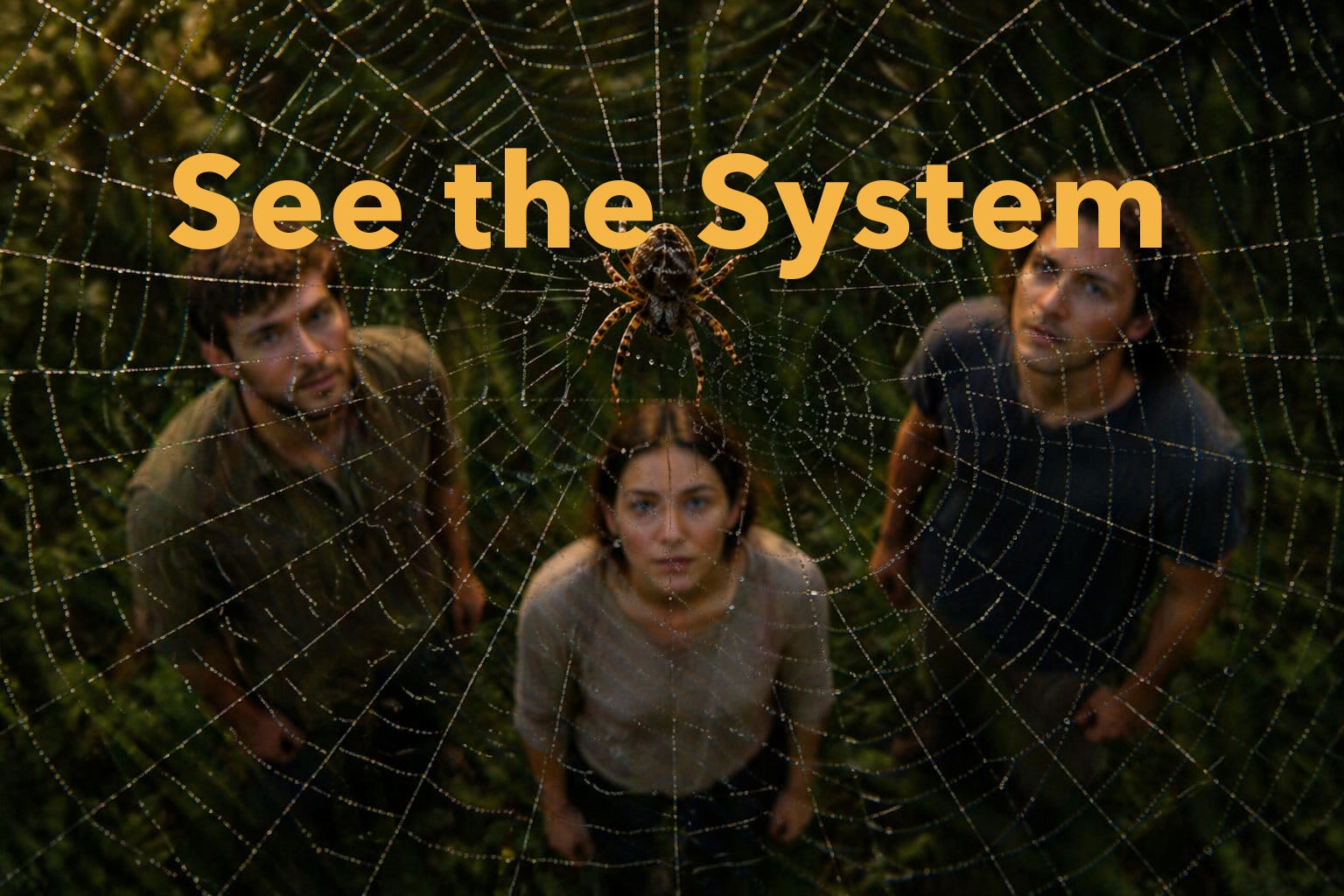
The spider does not dominate the web. It senses it.
That may be the more demanding image of leadership for our time. Not the strategist finding the hidden weakness. Not the operator pulling the right lever. But the person capable of feeling the whole structure vibrate, discerning what those vibrations mean, and responding in ways that strengthen coherence rather than fracture it further.
That is slower than manipulation. Less theatrical too.
But it is also wiser. More truthful. More enduring.
And in a century defined by systemic strain, it may be one of the most important forms of power we can recover.
Video Explanation
If you prefer to listen, this week’s 3-minute video explores Law 33 — Seek System Patterns, Not Manipulation.
Book editing continues steadily. Law 33 is part of the Ecological Wisdom cluster within the 48 Laws of Regenerative Power.
Next week I’ll share Law 34: Carry Sovereignty in Dignity