


Contents
Abstract
1. Introduction - Why the future of architecture is a civilisational question
2. Method - Regenerative Transition Scenario Method
3. Forces reshaping architecture
4. Critical uncertainties and scenario matrix
5. Scenario 1 - The Platform Order: Architecture at Scale
6. Scenario 2 - The Custodial Order: Regeneration by Mandate
7. Scenario 3 - The Bazaar Order: Open Design, Fragmented Purpose
8. Scenario 4 - The Commons Order: Collective Stewardship of Place
9. Cross-scenario synthesis - What changes across the Four Orders?
10. Civilisational reflection - Sorokin, Leonardo and the future architect
11. Preferred future - Commons-led, not Commons-only
12. Strategic experiments and Wind Tunnel results
13. Recommendations - Building the conditions for regenerative architectural intelligence
14. Early signals and watchpoints
15. Conclusion - The architect as integrative steward
Methodological Note
Endnotes
Bibliography
Abstract
Architecture is entering a period in which its inherited professional identity is no longer secure. Artificial intelligence is redistributing design agency. Ecological crisis is challenging the legitimacy of growth-oriented construction. Material scarcity, climate adaptation, circular economy imperatives and changing expectations of participation are altering the conditions under which buildings and cities are conceived. At the same time, the profession is being asked to reimagine its public value beyond the production of buildings, images, documents and expert services.
This FutureSense Paper applies the Regenerative Transition Scenario Method to explore how the role and identity of the architect might evolve between 2026 and 2050. The inquiry is anchored in the Australian architectural context while recognising the global forces reshaping design, construction, urban governance and ecological transition. It asks: How might the role and identity of the architect evolve between now and 2050, as the built environment profession navigates post-normal times shaped by AI disruption, ecological crisis and civilisational transition?
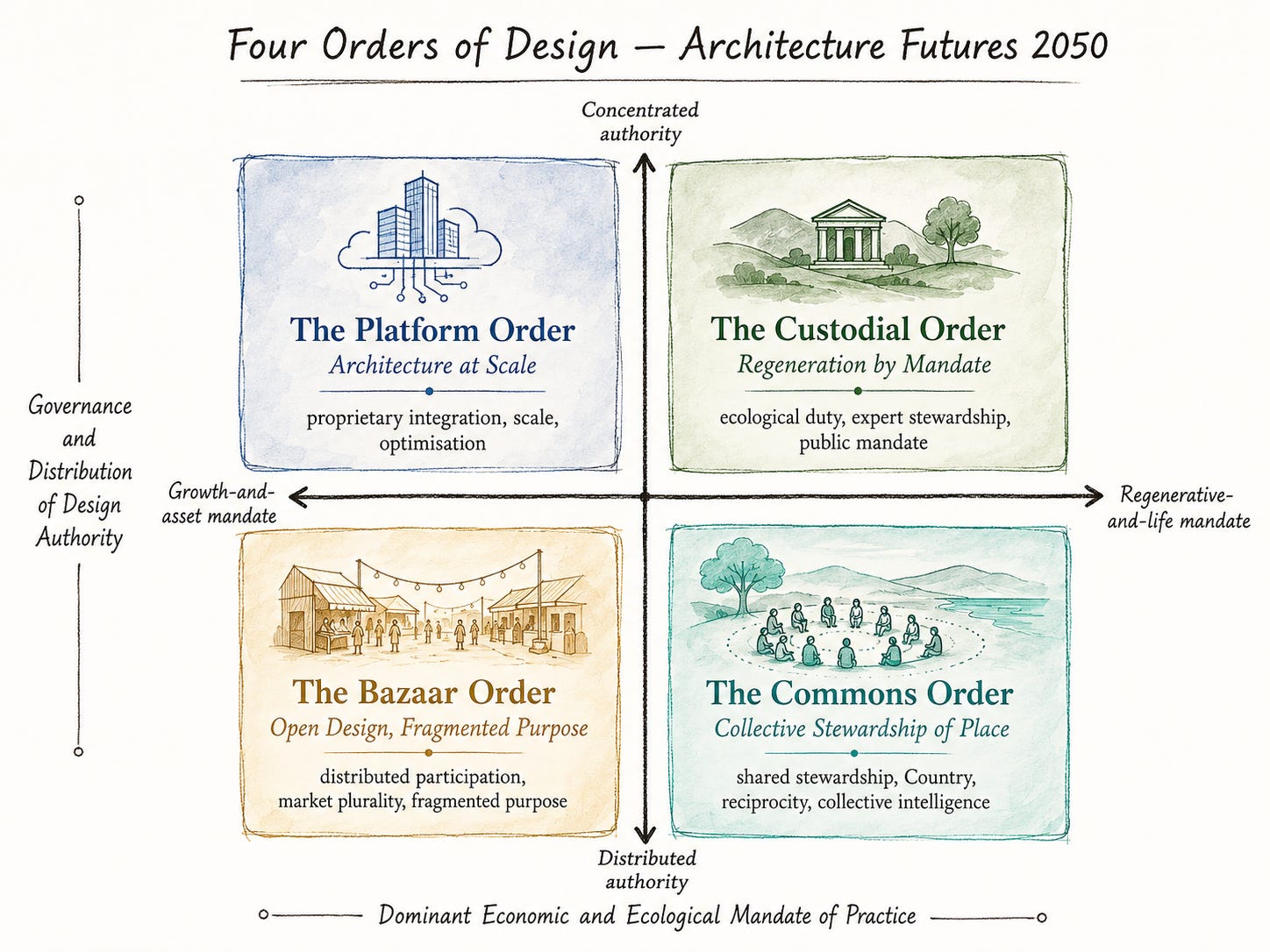
The analysis identifies two critical uncertainties: first, whether design authority becomes concentrated or distributed; and second, whether architectural practice remains organised around a growth-and-asset mandate or shifts toward a regenerative-and-life mandate. These uncertainties generate four future worlds: The Platform Order, where proprietary systems scale architecture through AI, finance and industrialised delivery; The Custodial Order, where concentrated public and professional authority enforces regeneration by mandate; The Bazaar Order, where design authority disperses through markets, communities and platforms while growth economics persist; and The Commons Order, where distributed authority and regenerative purpose align through collective stewardship of place.
The preferred future is Commons-led, not Commons-only. It requires the Platform Order’s integrative capacity without proprietary enclosure, the Custodial Order’s ecological discipline without paternalism, the Bazaar Order’s openness without fragmentation, and the Commons Order’s reciprocal stewardship as organising purpose. Strategy testing through a Scenario Wind Tunnel identifies four recommendation tiers: a robust competency framework across all futures; a mandate-dependent retention-first protocol; Commons-dependent prototypes for civic AI, Country-Centred authority and stewardship economics; and a high-leverage but fragile metropolitan assembly.
The civilisational reflection applies Pitirim Sorokin’s cultural pendulum to interpret contemporary architecture as a mature Sensate formation under pressure from ecological limits, professional fragmentation and a crisis of meaning. Leonardo da Vinci is used not as a model of solitary genius to be revived, but as a historical hinge for understanding integrative design intelligence at a civilisational threshold. The future architect’s deepest role may be that of integrative steward: a practitioner capable of making relationships visible, holding distributed intelligence together and giving spatial form to life-serving futures.
