

Release What Blocks Flow
Emergent Laws of Regenerative Power

The Table of Files
When I first arrived at Maroochy Council, I was shown the backlog.
A large table stood under the weight of building application files stacked five, sometimes ten, high. Buff manila folders rose like a small administrative mountain range. Each file carried a builder waiting, a client calling, a project stalled, a decision delayed.
The manager’s personal assistant explained the system behind the piles. There was a logic to it, apparently. A sequence. A way through.
But my body received a different message.
Three months of backlog.
The shock moved through me before thought could organise itself. My limbs felt drained. My stomach tightened. The fluorescent lights, the office noise, the ringing phones, the constant urgency all pressed in at once.
Then the calls began.
A builder wanted his duplex approval. Another wanted to know why the planning and landscaping conditions were taking so long. Another had a client breathing down his neck. I could hear the stress in their voices because it was now in mine.
By the second week, I knew I could not survive the pace by simply working harder.
The problem was not only the workload. It was the environment of interruption.
Every time I began to think, the phone rang. Every time a report started to form, someone asked a question. Every time I tried to move one file forward, ten more seemed to lean in with their own claim on attention.
So I found another room.
Twice a week, I stepped away from the open-plan pressure and crossed into the Heritage Library. Inside stood an oval silky oak table, made in 1930 by Poore & Flick in Nambour from a single ancient tree. For forty-seven years, that table had held the meetings of Maroochy Shire Council. Around it, civic decisions had been made, argued, recorded, and remembered.
I sat in the barrel-backed captain’s chair, crafted from the same tree.
Something in me settled.
The work changed immediately.
Reports that felt impossible upstairs began to take shape. Conditions sharpened. Recommendations emerged. The backlog began to shrink.
Not because I had become more efficient in the usual sense. Not because I had mastered time management. Not because I had pushed myself harder.
The flow returned because the blockage had been removed.
That experience stayed with me. Years later, I could see it as more than a survival strategy. It was a law of regenerative power revealing itself through municipal paperwork, bodily stress, and a heritage table made from silky oak.
Release what blocks flow, and life moves to meet you.
The Law Beneath the Story
This law is deceptively simple.
Many people assume flow is something we must create. We chase motivation, productivity, momentum, alignment, and growth as if they are scarce resources to be manufactured through force.
But often flow is not absent.
It is obstructed.
A team may already have intelligence, but be blocked by fear. A community may already have care, but be blocked by unresolved conflict. A leader may already have clarity, but be blocked by the need to preserve an old identity. An organisation may already have adaptive capacity, but be blocked by procedures designed for a world that no longer exists.
The work, then, is not always additive.
Sometimes the most regenerative act is subtractive.
Remove the pressure that fragments attention. Remove the story that no longer fits. Remove the incentive that rewards the wrong behaviour. Remove the silence that prevents truth from entering the room.
This is the reframe: power is not only the ability to hold more. It is the wisdom to release what prevents life from moving.
The River Does Not Need Coaching
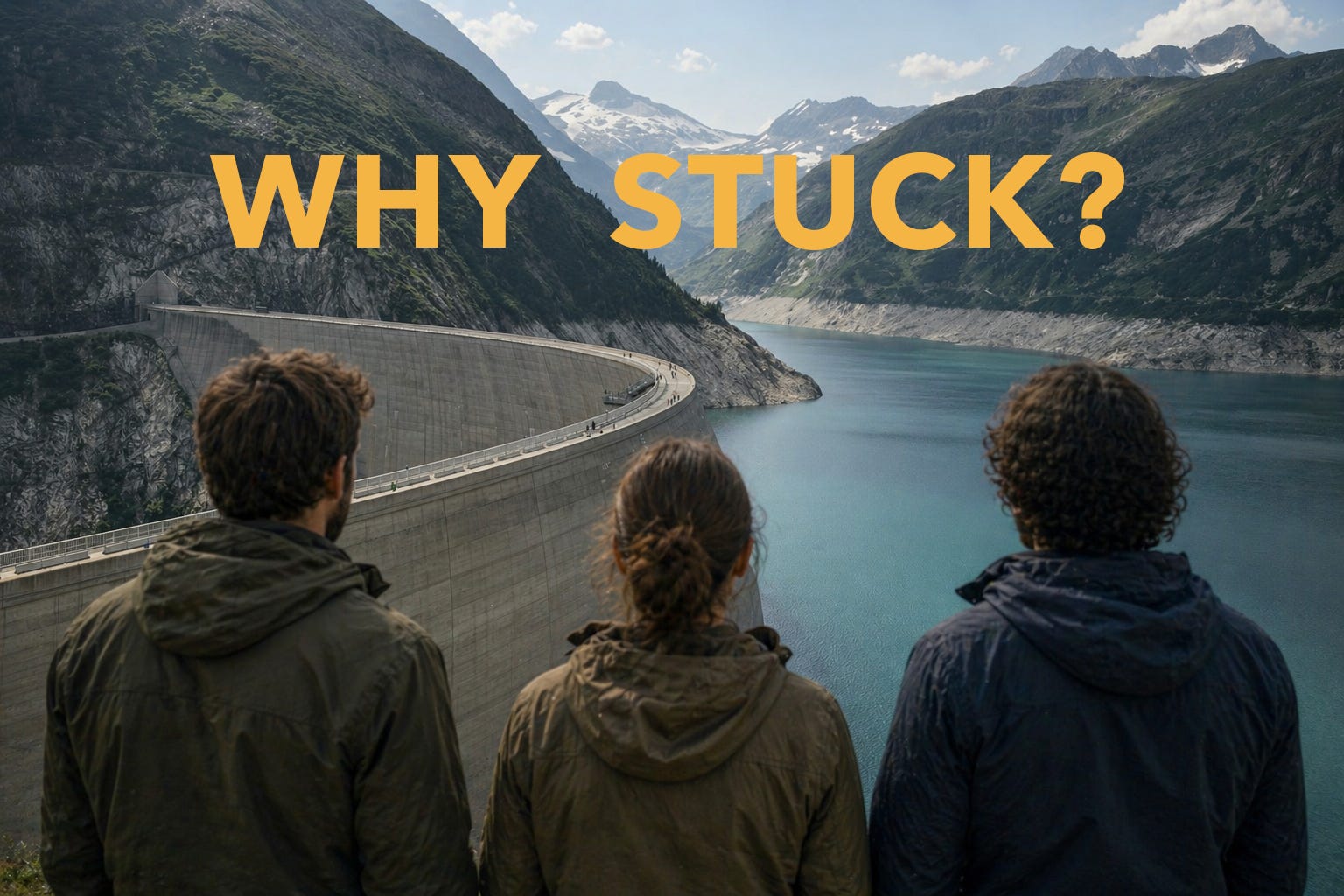
The metaphor for this law is a dam gate.
When you lift a dam’s gate, the river does not need coaching. It does not require a strategic plan for downward movement. It does not need a consultant to remind it of gravity.
It remembers its own way.
This matters because much of modern leadership still treats people, places, and systems as if they are inert. We assume movement must be imposed from outside. We design interventions. We intensify pressure. We add meetings, metrics, frameworks, incentives, and reporting structures.
Sometimes these are useful.
But sometimes they become the dam.
A living system already carries tendencies toward circulation, renewal, learning, and repair. The regenerative question is not only, “What should we add?” It is also, “What are we holding in place that stops the system from breathing?”
In my Council story, the backlog did not require heroic endurance. It required a release valve. A different room. A different sensory field. A place where thought could lengthen enough to do its work.
That small act changed the system around me.
What Biology Knows About Blockage
Living systems understand this principle intimately.
Inside the body, enzymes make life possible. They act as catalysts, enabling chemical reactions that would otherwise occur too slowly to sustain us. They do not force life into being. They lower the barriers so life can continue its work.
But enzymes can be inhibited.
When an inhibitor binds to an enzyme, the enzyme may still be present. It may still be structurally intact. Nothing has disappeared. Yet the reaction is blocked. The metabolic pathway stalls. Energy accumulates upstream. Downstream processes are deprived.
This is a powerful image for leadership.
A team may have the skill. A community may have the willingness. A leader may have the insight. A movement may have the moral force.
But something binds the active site.
Fear. Bureaucracy. shame. cynicism. fatigue. distrust. performative consultation. unprocessed grief. an outdated worldview.
The capacity remains present, but function is paralysed.
When the inhibitor is removed, the system does not need to be rebuilt from nothing. It resumes. It metabolises. It moves.
This is why regenerative leadership pays attention to blockage. Not as a deficit to shame, but as a pattern to understand. The question becomes: where is energy trapped, and what would allow it to circulate again?
Non-Attachment Is Not Withdrawal
Buddhist wisdom offers another layer.
In Vipassanā, the practitioner observes sensations, thoughts, and emotions as they arise and pass. Pleasant sensations are not grasped. Unpleasant sensations are not pushed away. Over time, one begins to see impermanence directly.
Everything moves.
The blockage comes from clinging and aversion. We cling to what we want to keep. We resist what we do not want to feel. We grip the desired future. We defend the familiar past. We try to control the river by tightening our hands around water.
This is not a call to passivity. Non-attachment is not indifference. It does not mean accepting injustice, abandoning responsibility, or floating above the world.
It means releasing the internal grip that makes wise action impossible.
A leader attached to being right cannot learn. A community attached to a single identity cannot adapt. An organisation attached to past success cannot sense emergence. A movement attached to purity can lose its capacity for relationship.
Release is not withdrawal from life.
It is fuller participation without the distortion of clinging.
When Silence Blocks the System
Audre Lorde understood another form of blockage: silence.
Her life and work revealed how unspoken truth can dam whole movements. When racism is silenced within feminism, feminism becomes partial. When sexuality is hidden within civil rights movements, liberation becomes conditional. When anger is pathologised rather than heard, energy that could transform the system is trapped inside the body.
Lorde’s work did not merely speak against oppression. It released blocked language.
She named the intersections others avoided. Black. lesbian. feminist. mother. poet. warrior. She refused to divide herself into acceptable fragments so that dominant systems could remain comfortable.
In doing so, she showed that speech can become a regenerative force.
Not speech as performance. Not speech as branding. Not speech as noise.
Speech as channel clearing.
When what has been suppressed is finally named, a system may resist at first. But something also begins to move. Grief moves. Anger moves. clarity moves. solidarity moves. Possibility moves.
This is why truth-telling can feel dangerous to systems built on blockage. It opens the gate.
Adaptive Capacity Begins With Release
Law 36 belongs to the larger territory of adaptive capacity because adaptation is impossible when energy is locked in defence.
A system cannot adapt while pretending the old model still works. A leader cannot adapt while protecting an identity that no longer fits. A city cannot adapt while planning for climate disruption with governance structures designed for stability. A culture cannot adapt while refusing to hear the truths held at its margins.
Adaptive capacity is not only the ability to change.
It is the ability to release what prevents change from becoming intelligent.
This requires discernment. Not everything should be released. Some commitments must be held with courage. Some boundaries must remain firm. Some traditions carry deep wisdom. Some forms of structure protect life.
The question is not, “How do I let go of everything?”
The question is sharper: “What am I holding that now holds me back?”
The Work of Letting Flow Return
When I think back to that Heritage Library, I do not see escape.
I see a young architect/urban designer discovering that the body knows when a system is blocked. I see a heritage table holding enough steadiness for thought to return. I see the first hint of a larger vocation forming beneath the pressure of ordinary work.
The backlog was real. The builders were real. The deadlines were real.
But so was the blockage.
Once I stopped trying to solve pressure with more pressure, something changed. The river found a channel. The work moved. I moved.
That is the deeper promise of this law.
Somewhere in your life, your work, your organisation, or your community, flow may not be absent. It may be waiting behind a gate that has been held closed for too long.
Name the blockage.
Release the grip.
Then watch what remembers how to move.
Video Explanation
If you prefer to listen, this week’s 3-minute video explores Law 36 — Release What Block Flow.
Book drafting continues steadily. Law 36 is part of the Adaptive Capacity cluster within the 48 Laws of Regenerative Power.
Next week I’ll share Law 37: Create Living Rituals
CONSULTING SERVICES
I clarify for my clients (cities and communities) a compelling place vision, cocreate impactful development processes, aiming for sustainable and regenerative place outcomes with a sense of compassion for people and the planet and then deliver these with coherence.
If you’d like to learn more about holistic and regenerative development, I can tailor a professional development workshop for you and your organisation.
Visit my website to learn more.