

The Infrastructure Between Us
Field Note from Poetic Designs

In March, when I wrote The Strait and the Threshold, I was trying to understand what the closure of the Strait of Hormuz was revealing about the architecture of the global energy system.
A narrow strip of water had exposed a very large vulnerability.
The essay explored four possible energy futures emerging from that disruption. At one extreme, Fossil Lockdown, nations respond by defending access to hydrocarbons with greater determination. At the other, Regenerative Transition, the shock accelerates structural movement towards distributed, renewable and more resilient energy systems.
Four months later, the conflict continues. The FutureSense scenario paper I developed from that initial inquiry has needed updating as pressure around Hormuz has persisted and instability has extended into the Red Sea.
Yet one part of the research now interests me more than it did in March.
It has less to do with energy technology.
It concerns whether we still possess the social capacity to change together.
An old idea inside a new crisis
The fourteenth-century North African historian Ibn Khaldun spent much of his life studying why civilisations rise, consolidate and decline.
Central to his thinking was asabiyyah, usually translated as group feeling, solidarity or social cohesion. Ibn Khaldun observed that societies with a strong sense of mutual obligation and common purpose could endure hardship and build formidable institutions. Over time, prosperity could weaken those bonds. Private advantage grew more attractive. Elites became detached from the wider social project. Eventually the institutions remained, but the cohesion that had animated them thinned.
His theory was developed in another time and another world. I would be wary of treating a medieval theory as some universal law of history.
But the pattern is difficult to ignore.
We have abundant renewable energy technologies. Storage continues to improve. Electrification is advancing. We know how to build microgrids, distributed generation, new transmission systems and increasingly sophisticated low-carbon fuels.
The problem is not simply whether these things can be built.
Who will build them together?
That question changes the energy-transition conversation for me.
Here is the reframing.
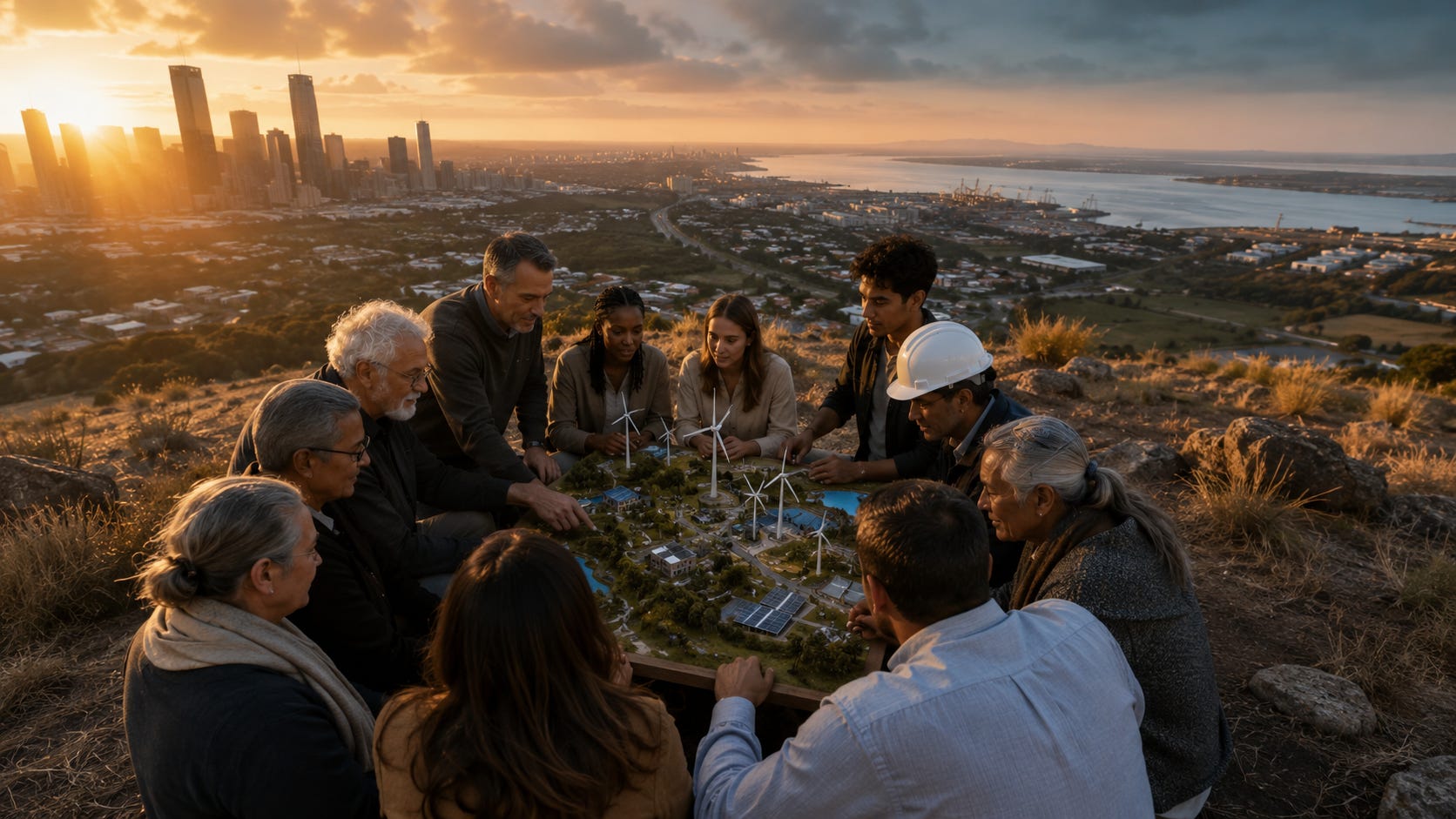
The energy transition is also a social cohesion transition.
Four futures of belonging
Look again at the four energy scenarios through Ibn Khaldun’s lens and something unexpected appears.
They are not only different energy futures. They are different geographies of solidarity.
In Fossil Lockdown, solidarity contracts. Nations defend supply routes, reserves and national interests. The future horizon shortens because immediate security overwhelms longer-term transformation.
In Competitive Transition, cohesion remains powerful, but mostly within national or geopolitical blocs. Countries decarbonise because energy sovereignty and industrial advantage demand it. We may get a cleaner energy system while reproducing many of the rivalries of the fossil age.
Managed Transition retains greater international cooperation, though without the shared purpose required for deeper transformation. Institutions manage risk. The system descends from fossil dependence carefully.
Only Regenerative Transition asks solidarity to widen.
Energy security, ecological security and economic renewal begin to be understood as interdependent. Countries still pursue their interests, of course. Yet they also recognise that some infrastructures cannot be secured effectively through national competition alone.
This is the least probable scenario in my current assessment.
That should make us curious rather than defeatist.
Build relationships while building infrastructure
As an architect and city strategist, I have spent much of my working life around plans.
Masterplans. Infrastructure plans. Development plans. Strategic plans.
Their lines can look wonderfully convincing on paper.
Then people have to build them.
And that is where the real system becomes visible. Governments, communities, landowners, investors, engineers, utilities and institutions all carry different interests, timeframes and definitions of value. Technical possibility is rarely the whole challenge.
This is why the most interesting strategic experiments emerging from the FutureSense scenarios are not simply new technologies.
Consider a regional zero-carbon aviation corridor. It requires airports, airlines, fuel producers, regulators, governments and supply chains to develop something together that none can create alone.
A biorefinery cluster linked with agricultural and industrial waste streams creates another web. Farmers, manufacturers, ports, energy companies and communities become participants in a regional metabolism rather than isolated sellers and buyers of commodities.
Cross-border renewable grids take the principle further. Electricity crosses political boundaries because geography rarely respects them.
And at the smaller scale, distributed community energy systems and microgrids can give citizens and regions a degree of ownership over the systems that sustain everyday life.
I find these experiments compelling because they build two infrastructures simultaneously.
The visible infrastructure carries electrons, fuels and energy.
The less visible one carries trust, reciprocity, knowledge and shared capacity.
We tend to fund the first and assume the second will somehow appear.
Perhaps that assumption is becoming expensive.
The deeper transition
None of this makes cooperation easy.
A renewable economy will still contain power struggles. Mineral supply chains can become extractive. Biofuel feedstocks can produce their own ecological conflicts. New technologies can reproduce old concentrations of ownership. A green system is not necessarily a regenerative one.
I think Ibn Khaldun would recognise that problem.
Civilisations do not renew themselves merely by replacing their technologies. They regenerate when sufficient shared purpose emerges to create institutions appropriate to a changed world.
That is what keeps drawing me back to the Strait of Hormuz.
A shipping chokepoint revealed the fragility of an energy architecture.
But perhaps it is revealing another vulnerability as well.
We may already possess much of the technology required to move beyond fossil dependence.
The harder infrastructure to regenerate may be the relationships between us.
In March I explored the four energy futures emerging from the Hormuz crisis in The Strait and the Threshold. The deeper scenario analysis, strategic experiments and Ibn Khaldun civilisational reflection are developed in my FutureSense research paper, The Strait and The Threshold: Four Energy Futures After the Hormuz Crisis.
References
Daffara, P. (2026a). The Strait and the Threshold. Poetic Designs.
Daffara, P. (2026b). The Strait and The Threshold: Four energy futures after the Hormuz crisis. FutureSense Research.
Darling, L. T. (2007). Social cohesion (‘asabiyya) and justice in the late medieval Middle East. Comparative Studies in Society and History, 49(2), 329–357.
Ibn Khaldun. (1967). The Muqaddimah: An introduction to history (F. Rosenthal, Trans., 2nd ed.). Princeton University Press.