


A FutureSense Signature Paper
Executive Summary
Quantum computing is usually discussed as a technical breakthrough or a cybersecurity threat. For city leaders, that framing is too narrow. The real issue is governance. Advanced computation may eventually help optimise metropolitan transport, water, energy, emergency response, land use, and logistics. But those benefits will not arrive automatically, and they will not be evenly shared. They will depend on who controls access, how systems are governed, and whether metropolitan institutions can coordinate across the fragmented jurisdictions that make up most large urban regions.
The central conclusion of this report is therefore direct. Quantum computing will not improve metropolitan life if metropolitan governance remains broken. This finding emerges from the scenario analysis and applies across all four futures examined.
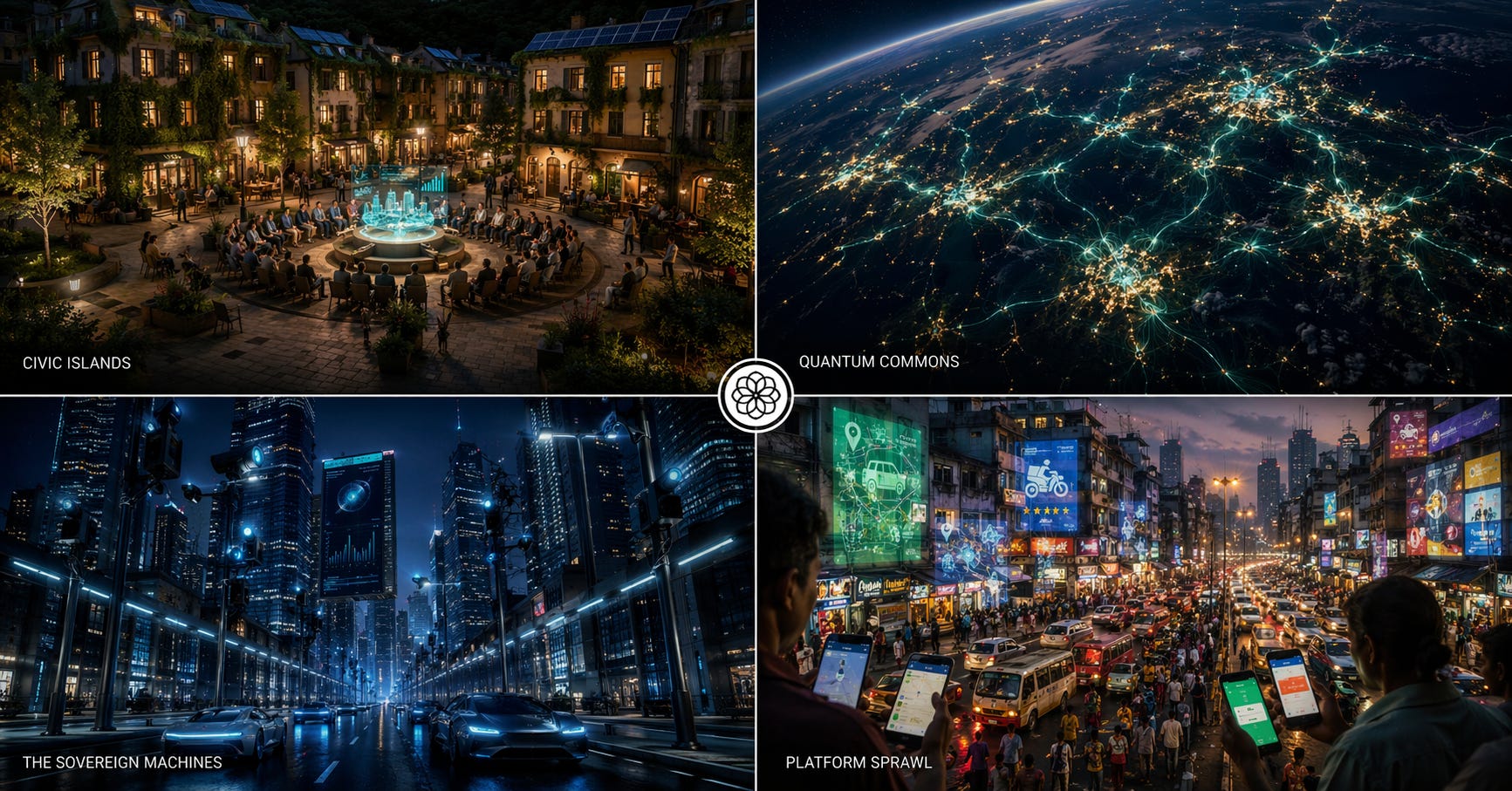
This report used the Regenerative Transition Scenario Method to examine how quantum computing could reshape metropolitan governance systems between now and 2050. Two structurally independent uncertainties shaped the analysis. First, whether quantum capability remains concentrated in a small number of wealthy cities or becomes more widely distributed. Second, whether adoption is governed through technocratic control or democratic-regenerative governance. Their intersection generated four futures: The Sovereign Machines, Civic Islands, Platform Sprawl, and Quantum Commons. These are not forecasts. They are structured worlds designed to test strategy, surface risks, and identify regenerative pathways.
The most probable near-term trajectories are the technocratic ones. The Sovereign Machines is currently the strongest pathway at 43%, because state security logics, proprietary infrastructure, and elite metropolitan concentration already fit the visible grain of the present. Platform Sprawl follows at 30%, as access may diffuse through vendors and cloud services faster than governance matures. Civic Islands stands at 17%, plausible but requiring institutional innovation before lock-in hardens. Quantum Commons sits at 10%, the least likely from today’s starting point but not unrealistic in principle.
Quantum computing will not improve metropolitan life if metropolitan governance remains broken.
The preferred future in this report is Quantum Commons, a world in which advanced computational capability becomes shared civic infrastructure rather than a competitive prize. The report does not assume that future will arrive. It shows how to move toward it from a less favourable starting point, and how to remain strategically effective even if the world drifts toward more closed or fragmented forms of urban intelligence.
The practical response is not to wait for mature quantum deployment. Five no-regret moves are available now: begin post-quantum security transition across metropolitan infrastructure, adopt public-interest procurement rules, build metropolitan governance literacy, create a computational governance compact, and strengthen metropolitan coordination architecture before advanced tools arrive at scale.
